Menopause
Progesterone and menopause are inextricably linked at many levels. Strictly speaking menopause only occurs when periods have finally stopped. It is generally recommended to allow a year to pass before drawing this conclusion. The symptoms which can be experienced in the years before its onset (sometimes referred to as peri-menopause) are generally far worse than those following after. In some women symptoms can start ten years before, sometimes they can persist from 5 to 10 years after.
Below is a comprehensive list of menopause symptoms...
- abdominal bloating
- agoraphobia
- aggression, anger, rage, resentment
- alcoholism, particularly pre-menstrually
- allergies
- anxiety, nervousness, irrational fear
- arthritis, joint and muscle pains
- blood clots
- breast tenderness
- bruising and capillary breakage
- chronic fatigue muscular weakness, procrastination, exhaustion, tiredness, mental confusion
- difficulty in getting up after enough sleep, lethargy
- clumsiness
- cold hands and feet
- constipation
- cracked heels
- cravings, eating disorders, binges, inability to tolerate long intervals without food
- cysts breast and ovarian
- dizziness
- depression - loneliness, uselessness, endless crying, irrational behavior
- fibroids
- guilt
- hair loss and excessive facial hair
- headache
- hot flushes and night sweats
- hypoglycaemia (low blood sugar)
- hypothyroidism
- incontinence
- insomnia
- irregular menstrual flow, heavy or light flow
- irritability
- lack of self confidence and esteem
- libido loss
- memory loss
- mood swings and irritability
- nails flaking, brittle and weak
- osteoporosis
- palpitations
- panic attacks
- personality changes
- skin problems - dry and early ageing
- sleep disturbances
- tension
- urinary tract infections, cystitis
- vaginal thinning, dryness and itching
- violence-verbal and physical
- violent dreams
- weight gain
- water retention
The Causes of menopause
Natural causes
Menopause normally occurs at an average age of fifty-one. Some women can reach their early sixties, whilst the youngest on record is nineteen. Smoking can reduce the age it begins by two years. An early puberty usually means a late menopause, but many factors can influence it's start.
Women are born with a finite number of eggs, all fully developed whilst she is still a foetus, peaking at several million. The current theory as to what causes menopause is that as a woman ages, the number of eggs declines and the ovaries shrink. At menopause, there are only about 1,000 left. But it is still only a theory, no one knows for sure.
At puberty the child starts developing into a woman. This is controlled by the affect of the two sex hormones estrogen and testosterone. Estrogen causes the breasts to grow and fat to be deposited, especially on the hips and thighs. Too much can cause a child to have very large breasts and fats deposits, causing the well known 'puppy fat'. One of the main reasons for puppy fat is a lack of progesterone, which opposes the action of estrogen, but not until ovulation occurs is this produced. Once ovulation starts the puppy fat generally goes. Testosterone increases libido, deepens the voice and causes body hair to grow. But too much can cause aggression, acne, large quantities of body hair and contribute to poly-cystic ovaries. Women produce about 80% less testosterone than men.
About two years after the onset of puberty menstruation begins. The cycle is governed by four hormones. Initially follicle stimulating hormone (FSH) stimulates the egg, and the follicle surrounding it, to grow and the ovary to make estrogen. Estrogen is the dominant hormone in the first half of the cycle, stimulating the buildup of tissue and blood in the uterus.
At mid cycle the pituitary gland produces luteinising hormone which stimulates the follicle to rupture, releasing the egg, which slowly makes it's way down the fallopian tube. The ruptured follicle, now called the corpus luteum, starts producing progesterone, the dominant hormone in the second half. Progesterone readies the endometrium (the uterine lining) for pregnancy. If the egg is fertilized it embeds itself in the lining and pregnancy ensues. If not, then the levels of both estrogen and progesterone drop sharply causing the lining to be shed.
This cycle continues until about ten years before menopause, when anovulatory (no ovulation) cycles begin. This is when the significance of the relationship between progesterone and menopause becomes apparent. When the anovulatory cycle happens no progesterone is produced during that month, but estrogen is still being made, leading to symptoms of estrogen dominance. Please refer to the above list for possible symptoms. As menopause approaches, anovulatory cycles increase, which in turn increases the amount and severity of the symptoms. By menopause the progesterone level can be as low as those in a man, but estrogen levels only drop when it finally arrives. Despite this women are often told the adverse symptoms which they've been experiencing are due to a drop in the estrogen level!
The link with progesterone is highlighted by the fact that women in industrialized countries have a hard time compared to women in rural societies. Dr. P. Ellison of Harvard University has studied estrogen levels in various ecological and cultural populations and has found that estrogen levels in western women are abnormally high. This can be due to a number of factors:
- the food we consume (particularly animals fed estrogen to fatten them)
- the crops sprayed with pesticides (most of which are estrogenic)
- the Pill and HRT
- drinking recycled water which has not had the estrogen removed
- using cosmetics which are made with liquid paraffin and estrogenic antioxidants
Many women are under great stress during peri-menopause having to juggle work and home, often a teenage daughter is going through puberty at the same time, children leaving home, a bad marriage, job difficulties and maybe elderly parents now need looking after.
An understanding of the effects of a lack of progesterone is key to undestanding that progesterone can play an enormously beneficial role in helping to go through menopause without too many adverse affects. By naturally opposing the action of estrogen, the symptoms of estrogen dominance are lessened and in some cases eliminated. The easiest method to apply progesterone is in a cream form.
New research conducted by Wallace and Kelsey and published in "Human Reproduction", indicates that it might be possible, using ultrascan on the ovaries, to show the approach of menopause. Currently blood hormone levels are used to try to determine this, but these are notoriously inaccurate as it is common practice to only check estrogen levels, not progesterone. The patient generally needs to specifcally request this despite the fact that progesterone and menopause are inextricably connected. As the symptoms of menopause are caused by a lack of progesterone and too much estrogen, the standard "estrogen only" test is of little help.
Menopausal women are actively encouraged to have Pap smears, mammograms or have a doctors examination on a regular basis. These have not been shown to reduce deaths from cancer, but merely enable earlier detection and treatment. (Please see page on cancer). Dr. P. Ellison suggests that the abnormal levels of estrogen in western women may be related to the current epidemic of breast and ovarian cancers.
Chemical causes
Menopause can be precipitated at any time in a woman's life by chemotherapy used in cancer treatments. The symptoms are the same as in natural menopause. Tamoxifen, the chemical used to control breast cancer, can cause severe hot flushes. Progesterone can be safely used to combat them.
Hysterectomy
By removal of the uterus and possibly the ovaries, a woman is in instant menopause. If the ovaries are not removed at the same time as the uterus, they will generally atrophy within two to three years. In the recent past, following a hysterectomy, women were usually given HRT. However, with the publication of studies finalized in 2004, which proved beyond doubt that HRT can cause an increase in cancer (particularly breast cancer), stroke and heart disease, this practice has declined. Unfortunately few medical practitioners recommend progesterone regardless of the clear connection between progesterone and menopause.
Causes of premature menopause
For reasons not too clear some women can go into premature menopause. One possible theory is the affect xeno-estrogens (xeno means foreign) have on the developing foetus. Xeno-estrogens mimic natural estrogen, but are extremely potent and highly toxic. Early exposure to estrogen or the xeno-estrogens can cause the follicles to mature rapidly and die off leaving few eggs in the ovary to reach puberty. This in turn leads to early menopause. Please visit the recommended web sites below for more on xeno-estrogens.
Turners' syndrome (TS)
Mention must be made of the 1:2000 girl babies born with TS. Again for reasons unclear, these children are born with an X chromosome either missing entirely or partially missing. Apart from many potential problems, they have non-functioning ovaries, which means no estrogen will ever be produced. So as the child approaches puberty, the lack of secondary sexual characteristics becomes apparent, no breast, thighs etc. develop. She is then given supplemental estrogen to correct this, but no progesterone to balance the estrogen. Unfortunately, under the misguided belief that estrogen prevents osteoporosis, (please refer to the page on osteoporosis), she is often put onto HRT. As TS was first reported as recently as the 1930's, it is possible that environmental poisons are to blame.
Now the all important question...
How to alleviate the symptoms of menopause?
There are two principal lines of approach...
- Nutrition and Diet (click link for full details)
- Progesterone
Depending on the severity of the symptoms, women should use between 100-200mg/day of progesterone. For more information please see...
'How to use progesterone cream'
Before using progesterone it's essential to first read about...
For information on...
progesterone application methods, see here
Menopause is a time when women begin to notice changes in their skin...
wrinkles, lines, sagging jowls. For practical solutions to aging skin
see this...Wrinkle Free Skin Tips Face Exercise.
Here's a chart comparing ml and teaspoons...
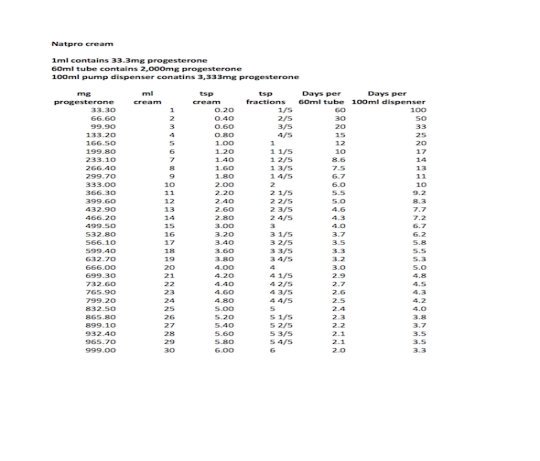
Menopause reference papers
Opinions differ as to the amount of progesterone needed, symptoms are the best measure.
Please click here to learn more about progesterone therapy in general.
Please read this wonderful poem by Peg Norton Hall...working for me...
Do you have a story about menopause?
We'd love to hear it. Sharing it will help us all get a better understanding of how to cope better with this inevitable time of life.
Do you have a story about menopause?
We'd love to hear it. Sharing it will help us all get a better understanding of how to cope better with this inevitable time of life.
Here's What Others Have Said
Click on the links below to see contributions and comments from other visitors to this page...
Post-Menopause age 69
Hello can anyone help me understand post menopause? I’m inquiring for my mother. Is progesterone still needed at age 69? All I keep reading is how estrogen …
Estrogen Surge
Hi all.. I've been on 400mg progesterone for 4 years. It took a long time to 'kick in', but eventually it worked and almost all my symptoms went away. …
Migraines and progesterone
Ive had a hysterectomy for 8 years now, severe frequent migraines have started within the last two years.
I am 53 years old and in fairly good health …
Progesterone to start postmenopausal bleeding
Hi.
I'm 53 and postmenopausal, 1 1/2 years. Two weeks ago, out of the blue, I started having constant pelvic pain. Went to doctor and transvaginal …
Hysterectomy and menopause
I am 53 years old and had a hysterectomy leaving ovaries April 2016 because of having so many fibroids. I had been anemic for so long that my ferritin …
Went straight from Nuvaring to Menopause
I just turned 50 and have taken some type of birth control since my early 20's. The latest has been the nuvaring that I've taken for the last 10 years. …
Ratio help in the UK
Finally got bloods done. These are my results:
Oestradiol 0.41nmol/per unit which am told equated to 410?
Progesterone 0.9nmol/per unit
Testosterone …
So happy to have found this thread!!!!
Hi everyone! I'm 33, finished nursing my third child at the end of December. I was waiting for my period to start once my milk dried up but instead I got …
HRT/Pellet Shot therapy
I received the pellet shot for hormone therapy. I was menopause for over 20 years. Once I started the progesterone 200my a day. I started extreme cramping& …
Menopause? Scheduled for hysterectomy in 13 days...still deciding.
Hello, I am 51, I will be 52 on January 4th. For most of my life I've suffered with bad pms. My cycles started at 12 yrs old. With that I also began to …
Fatigue and Bronchitis type symptoms up to 10 days before my cycle starts
Hi I am 51 definitely having menopausal symptoms like irregular bleeding, sometimes spotting after main period has stopped, some hot flushes, lack of labido. …
I just want the insomnia to go away--help dx me
I'm near 50 and have been on synthroid for hashimoto's for over a decade. Had throid cancer 10 years ago and there is a sliver of my thyroid left.
About …
PG/E2 ratio too high?
Went on Bio identical hormones four years ago at age 58. Felt great, lost 35 lbs. I also had one thyroid lobe removed, so am on Armour thyroid 120 mgs. …
Hysterectomy but left my ovaries to go through menopause naturally
My PA did a test to see if I was in Menopause... I am 55 years old and in excellent health-no prescriptions except for eye drops. Lab came back from …
Confused
I am post menopausal, had a partial histerectomy at the age of about 36 but still have my ovaries. About 10 years ago the dr put me on HRT beause my blood …
Low estrodiol level
I just got my saliva test results back and it says that I am low in estradiol and my progesterone is in range.
Estradiol (Saliva) 0.6 pg/mL 0.5-1.7 …
Pain and swelling: Will progesterone cream help?
Dear Wray, My order arrived today. Hurray! I could hardly wait to get started. So, I've already applied the progesterone to areas where it's needed.
…
New convert
I used progesterone on and off for some time during the last couple of years. Started menopause about 10 years ago and was on HRT and sleeping tablets …
HRT I would love a second opion please
I am a 52 year old woman who is post menopause. Last year my doctor prescribed estrogen to relieve my symptoms of menopause but then I developed polyps …
Ostioporosis greatly helped by natural Progesterone
My story is about the colour xrays taken two years apart have show about 23% increase in bone density in the neck of the Femur. This happened after they …
Progesterone in the elderly
I am 70 years old. I used hormone replacement therapy for a very short time in my late 50s. I suffer from terrible, chronic insomnia, which is no longer …
Post-Menopausal and doesn't seem like I am getting anywhere, except mor confused
My problems seemed to start in January of 2013. Went to see my primary physician and he ran blood labs. I had been taking Natural Progesterone 20mg daily. …
Menopause and Varicose Veins
Hi. I am in menopause and suffer from superficial varicose veins - so am unable to use HRT. I suffer badly from hot flushes, dry vaginal, facial hair, …
A Little Scared about Weight Gain and Bioidentical Progesterone!
I've been reading over your website including the questions and answers and am pretty excited that I may have found the answer to the nightmare of menopausal …
Advise Me if I'm on the Right Track...
Hi Wray. I've been on Natural Progesterone for 5 months, Natpro for 3 of those. I was applying about 1 - 1 1/2 tsps daily yet the symptoms of Estrogen …
Hormone migraines
I had partial hysterectomy at 42. Long history of hormone migrains led to week long headaches now at menopause 7 years later. They just wont go away. Even …
Surgical Menopause at age 29, wish I would never have done.
At age 29 my doctor recommended I have a hysterectomy because he found a mass on my ovary. Well he removed my uterus, fallopian tubes, and one ovary and …
Perimenopause, Estrogen Dominance and Adrenal Fatigue
I recently posted a thread about my prolonged bleeding due to perimenopaue and estrogen dominance.
Some of the readers might recall that in the fall …
"Extra" periods and use of progesterone cream
I'm clearly entering the pre-menopause phase, as my cycles seem to be all over the place. I am 48 this year, and have used progesterone cream on prescription …
I am a menopause woman now, how long do I need to take progesterone and estradiol?
Hi i 've been with night sweat and hot flashes for about 3 years, and it really comes and go, but now after my last blood test FHS it shows that I am …
Menopause, Hair Loss, and Too Much Estrogen
It’s no secret that menopause means you will be experiencing lots of bodily changes. But what you may not have been expecting is for menopause to cost …
Mammography Screening Linked to Overdiagnosis of Cancer
Ann Intern Med. 2012;156:536-537
Mammography Screening Linked to Overdiagnosis of Cancer
Oestrogen - an inflammatory hormone
Fox Chase Cancer Center April 3, 2012
Scientists at Fox Chase Discover Link between Estrogen and Tobacco Smoke
The FASEB Journal vol. 26 no. …
Will it help with palpitations?
Hi, I'm 53 and having hot flashes and as if someone flicked a switch my joints are aching and I'm having heart palpitations every few minutes 24/7. I've …
Menopausal lips!!
I have to tell this as it quite simply astounded me.
I have been lucky enough to just bumble along most of the time as regards menstrual issues etc. …
My hot flashed stopped when I started...
...taking Resveratrol. I am happy to share my experience :))
measuring hormonal levels
Hi, Dr Mercola states that the best way to measure levels of hormones is by a 24 hour urine test. Has anyone ever done this? He also says that only …
Help
Hi your website isn't working. I can't order Natpro and when I send a message it doesn't look like it goes either.
Thoughts?
Hi there I've just …
Using progesterone for three weeks is helping but I still have no energy. Zule from Colorado.
I started perimenopause at the age of 36 I am now 41. About two months ago my symptoms got worse; depression, insomnia, very sentimental, etc.( and on …
Depression and weight gain
I am 56 years old, I got my period at an early age and went through menopause at the age of 42. I have always fought depression, mostly seasonal effective …
I wore Depends at night every cycle beginning in my late 40s
Each month I felt like I had the flu just for those days. Then I was fine again. I had one hand that shook. My period stopped on a dime. August of 2008 …
energy levels good, skin not so good at menopause
This is my story, have some menopause symptoms, persistant swollen feet, not bad but ugly, have sore throat 3 times in two months leading to flu like …
Menopause, I wish I read this in my thirties instead of 55
I lost my virginity and got my first abortion at 21. After that got married and had 2kids with 2 successful non complicated pregnancies.
Then I had …
Continuous Period on Progesterone
I am 52 and menopausal. My periods stopped about 8 months ago and I did not have a period for months. Then I started using Progesterone Cream without a …
Menopause And Your Life After That
“I thought my life had ended when I had a TAH & BSO done before I reached menopause. I was only 40 years and due to risk of ovarian cancer and since I …
Menopause - wish it were over!
Menopause was very confusing for me, and still is, because my doctor never explained how it worked. Even now, my obgyn calls me "post-menopausal," even …
I am not in Menopause
I have thinning of the uterus. The doctor at first thought maybe I had cancer cuz of that. But after having a blood test to see if I was in menopause I …
Low thyroid
Hi Wray, I've just been diagnozed with hypothyrodism only 5 weeks ago my tsh level was 3.79 now its 9.1. I am very fatigued and have put weight on. …
Im 48 and I think I'm peri-menopausal
For some time now I have been feeling fuzzy headed, exhausted all the time, even after a good nights sleep, very poor short term memory, and working in …
How old is too old to use natural progesterone?
I don't have a story. I have a question.
I am 68 years old and have been using Natpro off and on for several years. Most recently I have used it daily …
Progesterone, dhea, melatonin and estroil/testosterone
Hi Wray, I was hoping if you could help me make a decision. My progestorone level in blood came back 0.8 in saliva 20. My bio identical docter wants to …
Menopause Vaginal Dryness
I am 55 and haven't had a period for two years. I have been fairly lucky and haven't suffered greatly while going through the menopause. However, of late …
Facial hair and progesterone cream
I have a question. I am on a daily dose of natural progesterone cream (5ml) and I'm noticing some wonderful benefits. My skin is glowing and my acne is …
A work in progress
I'm 42. I was on BC pills for 20 years up until a little over a year ago. I took myself off the BC pills because I was afraid they were the source of my …
13 years on bio-identical hormones
I am 63 years old and was just diagnosed with a class 1 endometrial cancer. Sept 09 I switched from using estriol rub on to the vaginal estriol.
My …
Menopause caused my itching
I am a 54 year old post menopausal woman. When I stopped my period at 51 I started itching and it hasn't stopped. Some of my symptoms were: hot flashes, …
Hot Flashes will not go away
I was using Maca supplements and they stopped my hot flashes. Then I moved onto progesterone cream and found it helped with my other peri-menopause symptoms …
Menopause 3 years ago period stopped
Now I have occasional bleeding, why? Is that normal? I am very confused trying to find out why? I feel very scared about this stopping period over 3 years …
Brief period of menopause, and glad they are gone!
I am now in my 70s, but since I first started having periods they were minimal, and over the years they have continued to be so I was told I would probably …
I have been on the cream twice a day
It really seems to help, I sleep better and my heart stops racing, not many hot flashes anymore. I just wonder is it bad on your heart, or does it at all …
Finally Doctor helps me with menopause
I have had menopause symptoms for over 2 years and they made my life miserable. No more periods for a year now and was trying everything from natural products …
Heavy bleeding
I have been taking 20mg of natural progesterone for approximately 15 days. I am 56 and had not had a period since one and one-half years ago. On the 10th …
Lack of energy
The first of the year I began having menopause symptoms. I turned 51 on 5/29. I can cope with the symptoms I'm having but feeling tired and sleepy all …
Peri-menopause and seizures
About 2 years ago I started having very strange "disconnect" on my right side. It was really scary. I had an MRI and there was nothing abnormal about it. …
I'm started into the menopause
My periods are only coming about every 5 months now, so not sure how to use the cream, but ordered it anyway. As I don't have a day 14 really how will …
Do you have a
question or concern?
See what's being discussed, ask for help, give your thoughts or experiences, or just browse...
or
Recent Articles


-
Does progesterone cream help with weight loss?
Apr 26, 24 03:01 AM
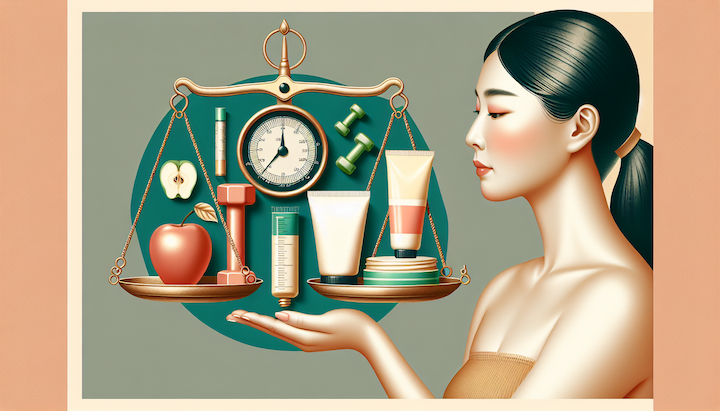 Struggling with weight gain or not being able to shed excess mass? If you have addressed your diet and exercise regime then you may want to look into the role hormones play in the arena of weight mana…
 -
Discover the Top Organic Progesterone Cream Brands
Apr 25, 24 11:34 AM
 Finding natural solutions to hormonal problems is a quest for many women worldwide. Organic progesterone creams emerge as a favoured choice offering a natural balance without the complications attache…
 -
binging
Apr 24, 24 03:40 AM
Does progesterone help with binging? since starting it it felt like my urge to binge mellowed out, but now that I'm having pms I feel like binging again. -
The Essential Role of Bio-Identical Progesterone Cream for Perimenopause Symptoms
Apr 24, 24 01:16 AM
 Navigating perimenopause, a period when progesterone becomes crucial for a woman’s well-being, can be quite challenging as one grapples with an array of symptoms. From the age of around 35, the produc…
 -
breakthrough bleeding
Apr 02, 24 03:45 AM
Age 38 - Started progesterone after having a period at the beginning of March (periods are not regular...typically along cycle with heavy bleeding at the
Natural
progesterone cream
Your language
Translate this website
into your language
Is this the future
of medicine?
Its free and will bring you important new information on progesterone therapy and related health matters
Home | Contact | Newsletter | Index of Symptoms | News | Progesterone cream | Privacy policy | Blog | About | FAQ
Disclaimer:
Although this web site is not intended to be prescriptive, it is intended, and hoped, that it will induce in you a sufficient level of scepticism about some health care practices to impel you to seek out medical advice that is not captive to purely commercial interests, or blinded by academic and institutional hubris. You are encouraged to refer any health problem to a health care practitioner and, in reference to any information contained in this web site, preferably one with specific knowledge of progesterone therapy.
