Peri-menopause
Peri menopause is a time when progesterone is vital for well being. Levels start dropping from the age of thirty five, whereas oestrogen remains at normal levels until menopause, when they drop sharply.
The reason for the drop in level is anovulation. From thirty five onwards ovarian function declines, ovulation does not occur every month, and progesterone levels in those months will be very low.
For ovulation to occur an egg needs to reach maturity, the following explains what happens in the cycle.
The first half of the monthly cycle is known as the follicular phase, and it can range from seven days to twenty-one days. Progesterone is present in extremely small amounts, oestrogen and follicle stimulating hormone (FSH) being the dominant hormones.
When the egg has reached maturity, another hormone called lutenising hormone (LH) is released by the pituitary. Approximately twenty four hours later this causes the Graafian follicle to rupture releasing an egg, commonly known as ovulation. The follicle, which is now called the corpus luteum due to its yellow colour, starts producing progesterone, which it does for the next fourteen days, progesterone is now the dominant hormone. This part of the cycle is known as the luteal phase.
During peri menopause cycles become very erratic, bleeding can be very light to flooding, 2 weeks apart to 3 months apart, clots, spotting, sometimes pain.
Although progesterone can normally be used to regulate the cycle, unfortunately no amount is going to regulate it once peri menopause has started.
It's the imbalanced ratio of the two that causes the symptoms. Both serum and saliva tests can be done to check levels of hormones, saliva being the more accurate of the two. This is difficult in peri menopause when cycles can be so erratic, nevertheless the following is an example of what the ratios mean.
It is most important to have the test done on the correct day, as cycles can vary from twenty one days to thirty six days. So in a thirty six day cycle the test should be done on day twenty nine, a twenty one day cycle on day fourteen.
The reason for this is the luteal phase is always, no matter how long or short the cycle, the last 14 days before bleeding. The peak would always be ±7 days before bleeding.
The second and most important issue during peri menopause is the ratio between the two hormones.
For instance if a woman has an oestradiol level of 13.2pmol/L and a progesterone level of 259pmol/L she would feel awful, and yet they are both in the 'normal' range.
On the other hand if she had an oestradiol level of 5.5pmol/L and a progesterone level of 979pmol/L she would feel wonderful, and yet these are also in the 'normal' range.
For full details of all the references ranges see the page on Hormone Testing.
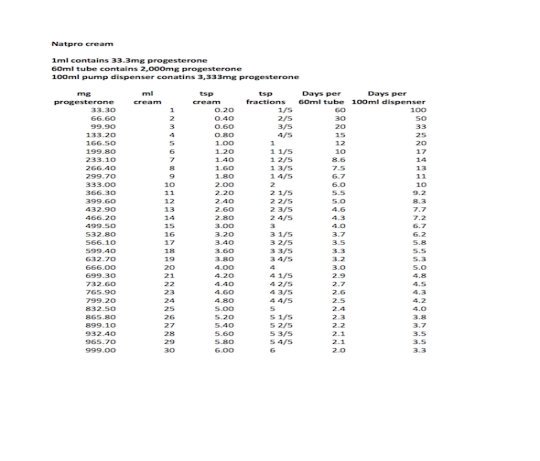
All the successful studies done on progesterone use between 100mg to 200mg per day. This equates to 3ml to 6ml of Natpro per day. Some go as high as 400-600mg/day, one as high as 1200mg/day as it was the oral variety.
For information on how to use progesterone cream and progesterone application methods in general click these links.
In some women symptoms can start ten years before menopause, the average age of which is fifty one, sometimes they can persist from 5 to 10 years after.
Below is a comprehensive list of the symptoms that can occur during peri menopause...
- abdominal bloating
- agoraphobia
- Aggression, anger, rage, resentment
- alcoholism, particularly pre-menstrually
- allergies
- Anxiety, nervousness, irrational fear
- arthritis, joint and muscle pains
- blood clots
- Breast tenderness
- bruising and capillary breakage
- Breast cysts
- chronic fatigue - muscular weakness, procrastination, exhaustion, tiredness, mental confusion, difficulty in getting up after enough sleep, lethargy
- clumsiness
- cold hands and feet
- constipation
- cracked heels
- cravings, eating disorders, binges, inability to tolerate long intervals without food
- dizziness
- depression - loneliness, uselessness, endless crying, irrational behaviour
- Fibroids
- guilt
- Hair loss, and excessive facial hair
- headache and Migraines
- Hot flushes and night sweats
- hypoglycaemia (low blood sugar)
- hypothyroidism
- incontinence
- insomnia
- irregularMenstruation, heavy or light flow
- irritability
- lack of self confidence and esteem
- Libido loss
- Memory loss
- mood swings and irritability
- nails - flaking, brittle and weak
- Osteoporosis
- Ovarian cysts
- palpitations
- panic attacks
- personality changes
- skin problems-dry skin and early ageing of the skin
- sleep disturbances
- tension
- urinary tract infections, cystitis
- vaginal thinning, dryness and itching
- violence-verbal and physical
- violent dreams
- weight gain
- water retention
Here's a chart comparing ml and teaspoons...
Do you have a
question or concern?
See what's being discussed, ask for help, give your thoughts or experiences, or just browse...
or
Recent Articles


-
Does progesterone cream help with weight loss?
Apr 26, 24 03:01 AM
 Struggling with weight gain or not being able to shed excess mass? If you have addressed your diet and exercise regime then you may want to look into the role hormones play in the arena of weight mana…
 -
Discover the Top Organic Progesterone Cream Brands
Apr 25, 24 11:34 AM
 Finding natural solutions to hormonal problems is a quest for many women worldwide. Organic progesterone creams emerge as a favoured choice offering a natural balance without the complications attache…
 -
binging
Apr 24, 24 03:40 AM
Does progesterone help with binging? since starting it it felt like my urge to binge mellowed out, but now that I'm having pms I feel like binging again. -
The Essential Role of Bio-Identical Progesterone Cream for Perimenopause Symptoms
Apr 24, 24 01:16 AM
 Navigating perimenopause, a period when progesterone becomes crucial for a woman’s well-being, can be quite challenging as one grapples with an array of symptoms. From the age of around 35, the produc…
 -
breakthrough bleeding
Apr 02, 24 03:45 AM
Age 38 - Started progesterone after having a period at the beginning of March (periods are not regular...typically along cycle with heavy bleeding at the
Natural
progesterone cream
Your language
Translate this website
into your language
Is this the future
of medicine?
Its free and will bring you important new information on progesterone therapy and related health matters
Home | Contact | Newsletter | Index of Symptoms | News | Progesterone cream | Privacy policy | Blog | About | FAQ
Disclaimer:
Although this web site is not intended to be prescriptive, it is intended, and hoped, that it will induce in you a sufficient level of scepticism about some health care practices to impel you to seek out medical advice that is not captive to purely commercial interests, or blinded by academic and institutional hubris. You are encouraged to refer any health problem to a health care practitioner and, in reference to any information contained in this web site, preferably one with specific knowledge of progesterone therapy.
