Progesterone Therapy
Progesterone therapy has been practiced for over 60 years in the treatment of a wide variety of symptoms and diseases that are hormonally related. During this time no adverse side affects have been reported. Some people have benefited from it continuously for over 40 years.
There is no evidence to suggest it is possible to overdose using progesterone therapy.
Hormones are chemical messengers and can only work once inside the nucleus of a cell. To get into the nucleus the hormone needs a carrier which is called a receptor. Receptors are very specific, they will only transport the hormone for which they are made. Progesterone receptors will not transport the synthetic progestogens into the cell nor will they transport progesterone itself if there is adrenalin in the blood. See here.
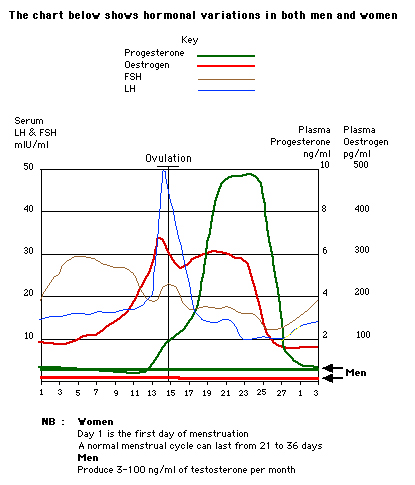
The level of progesterone varies in women from approximately 5mg per day in the first half of the monthly cycle up to 50 mg per day in the second half. During pregnancy the placenta produces up to 40 times the highest amount made when not pregnant. Men make from 5 to 15mg per day on a continuous basis.
Here's an important word of caution...
Tests to find the level of progesterone in the blood of women are generally of little value for a number of reasons...
- the ovary secretes progesterone in small spurts and the amount can vary within half an hour
- low levels have been found in women who are not ovulating
- if adrenalin is present or the blood sugar is too low even high levels of progesterone cannot be used
- after a large meal the level of progesterone drops
- the level drops during the long nights experienced in northern latitudes
- progestogens contained in the Pill or HRT lower the level of progesterone
Progesterone therapy is usually administered in a cream or oil base, which means that it will be carried in the blood on a red blood cell membrane. Often tests only check the plasma which would show up little or no progesterone.
So what can you do for reliable results?
Saliva tests are generally more reliable. However, if you are a woman and if a blood test is your only option then make sure this is done during the 5 to 10 days before your next period. This is to check whether ovulation has occurred, as the level should then be at its highest point.
To find out why the saliva test is the only reliable one (and more)...
...please click here for a specialist's comments.
A blood test is not a necessity. Simply trying progesterone therapy and seeing its effectiveness in dealing with your health problems is the easiest course of action as it is inexpensive and risk free.
Progesterone therapy can be administered in many forms...
- transdermal creams varying from under 1% to 10% in strength, which are an effective, slow release form
- sublingual oil or tablets, giving a quick release so not suitable for long term use
- injections, very effective at treating emergencies such as epileptic, migraine or asthmatic attacks, but not for long term use
- suppositories, again a fast release form so not suitable for long term use
- orally administered capsules, which are ineffective, as up to 90% is destroyed by the digestive system and the liver before reaching the receptor sites
Transdermal creams are the most commonly used form of progesterone therapy for a number of reasons, some of which are...
ease of use; cost effectiveness; can be used over a long term; direct benefit to the skin, making the use of other moisturizers unnecessary
See here for full details on progesterone application methods.
When using progesterone therapy it is essential to start on a high dose. Some practitioners give 2500mg/day for very severe cases of post natal and manic depression, PMS, panic attacks, temporary psychosis etc. See here, here, here and here.
After the initial high dose, which should bring relief in anywhere from three days to three months, it may gradually be reduced until the reappearance of symptoms.
This indicates the level of progesterone needed. As it is the precursor to the stress hormones any extra stress will require increased levels of progesterone therapy.
Once started on progesterone therapy you will become sensitive to the level needed on a daily basis. However, here is some additional guidance for you...
When to Use Progesterone Therapy
How Much Progesterone Cream to Use
The cream can be used at any time of the day and, if preferred, on more than one occasion, but no less than twice a day, as progesterone levels drop after about 13 hours.
It can be applied to any part of the body and does not have to be used only on the thin skinned areas as is sometimes recommended. The skin comprises 95% kerotinocytes, which have a plentiful supply of progesterone receptors, even the hair follicles absorb it well.
Please note the amount suggested is a guide only as each individual is different. It's only by trial and error that the correct amount is found. Another point to remember is that stress drops progesterone levels sharply so apply more to prevent the return of symptoms.
Progesterone should always be used dependant on symptoms and not on 'dose'. If symptoms are severe more will be needed, if mild then less.
Generally between 100-200mg/day of progesterone (that is 3ml to 6ml of cream) is needed.
Please note... The figures below showing quantities of progesterone cream are based on a concentration of 3.33% progesterone as is the case with a 2oz (60 gram) tube of Natpro cream containing 2000mg (2 grams) of progesterone.
See this page for more information on Progesterone dosage.
Women
- Menstruating
- if a cycle is present apply the cream twice daily from ovulation for the next 14 days, bleeding should occur within a day or two. The luteal phase is always 12-14 days in all women, any less and it's known as a 'defective luteal phase' Cycles vary from 21 days to 36 days. For instance in a 21 day cycle the cream should be used from day 8 for 14 days, if a 28 day cycle from day 15 for 14 days, and if a 36 day cycle from day 22 for 14 days
- Peri or post Menopausal, Hysterectomy, Oophorectomy, Pre-pubertal, Pubertal
- if there is no cycle, or an erratic one too difficult to follow, apply the cream twice daily. There is no need for a break as some suggest, although some women prefer to have one. Either is fine.
- Severe symptoms
- hot flushes Use at least 400mg/day for 4-5 days, this generally stops them. It's best to apply the cream hourly
- heavy, continual bleeding 400-600mg/day from 1 to 3 months, ignoring the cycle. When the bleeding has stopped, slowly reduce the cream until bleeding occurs again, then discontinue the cream for 14 days. Then start again from day 15 for 14 days. Over the coming months the natural cycle length will assert itself. It's best to apply the cream hourly
- a multitude of bad symptoms Use a minimum of 200mg/day following the cycle, more might be needed. If symptoms return during the break, then continue applying the cream twice daily or more frequently until they resolve. Once they have then begin following the cycle again
Men
Use from 10 to 100mg/day of progesterone (that is 0.3ml to 3 ml of cream).
It's best applied twice a day.
See here for full details on...
'How to use Progesterone Cream'
Rub the required amount of cream thoroughly into the skin on any part of the body.
Important note for women... If you have been on HRT (hormone replacement therapy) or have a naturally high level of estrogen, progesterone will make you more sensitive to the estrogen in your body. Because of this, for the first two or three months the symptoms caused by excessive estrogen may affect you. If this is the case it is advisable to increase the daily application of progesterone cream, with the advice of your health specialist, until these symptoms have gone.
The main symptoms of excessive estrogen are...
breast tendernessbloating/weight gain from water retentionspotting or a temporary reappearance of your periodsheadaches/migraines/dizzinessheart palpitationshypoglycemiaaches and pains or bruisingdepressiontiredness/chronic fatiguehot flushesmood swingsangerskin problemsnausea
Before using any progesterone cream it is important to read this page first...
If you are on HRT and wish to discontinue it, the gentlest course is to taper off taking the pills/patches/inserts over a period of 2-6 months. Adjust the tapering off period according to the severity of previous symptoms and how long the HRT was taken. See here for full details...
For more information on what are often, but wrongly, perceived as progesterone side effects click here.
Simple Progesterone Test
An elevated progesterone level induces an increase in body temperature. Women can measure their temperature by using a thermometer. A rise in progesterone is indicated by about a 0.4 degree Fahrenheit increase and a fall of progesterone, triggering menstruation, indicated by a decrease in temperature.
A thermometer can also help in determining if you are progesterone deficient during pre-menopause years. (Post menopause women are not ovulating and menstruating and have constantly low progesterone levels so progesterone level changes will not occur.) Your temperature should rise at ovulation and remain high until a day or two so before the end of the cycle and the start of menstruation. Fluctuations may occur due to a "double ovulation". Although this is rare it is possible within three days of initial ovulation or due to sickness.
If your temperature never rises (indicating no ovulation) or consistently drops several days after ovulation and stays low for days thereafter it is very probable that your progesterone levels are not being adequately maintained. Low progesterone levels can contribute to miscarriages and osteoporosis and numerous other symptoms of estrogen dominance. To verify your findings the only reliable method is saliva hormone testing.
"...saliva hormone testing is more convenient, less stressful, more cost-effective, and more representative of the bioavailable fraction of hormones in blood than serum hormone testing. When hormones are delivered topically, serum hormone testing grossly underestimates the bioavailable fraction of hormones in blood and tissue hormone uptake and response..."
Dr David Zava.
To read more and to find out why the saliva test is the only reliable one please click here.
A General Observation about drugs
Some drugs may be dispensed with once progesterone therapy has been started, most notably the anti-depressants. Always taper off slowly and with the advice of your health specialist.
Any additional stress, good or bad, can cause your symptoms to recur. If this should happen then increase the daily application until they have gone.
If you would like to find out more about progesterone therapy please click here.

Natpro
bioidentical progesterone cream has helped tens of thousands of women and men suffering from many health conditions since 1996.
To buy now, click here...


For more detailed information on Natpro click here.
Do you have a
question or concern?
Recent Articles


-
Progesterone and oral health during menopause
May 10, 25 04:04 AM
I am interested in finding out if there are any benefits from progesterone cream for oral health in menopause. The articles I have read mention synthetic -
Confused about blood test results
Apr 25, 25 02:37 AM
Hello, I have recently had blood tests done for estradiol and progesterone on day 5 of my cycle on April 16. i am definitely in perimenopause the last -
Upping the dose for progesteone Therapy?
Apr 23, 25 02:22 AM
Unfortuantely I just posted my qustion under someone else's question. I do apologise as it shouldn't have gone there, so I'll write it here under a new -
Exhausted from insomnia caused by night sweats
Apr 22, 25 05:15 AM
At 34 I lost my first pregnancy due to water breaking at 16 weeks. Second pregnancy required trans-abdominal-cerclage(TAC) placed by surgery at 19 weeks. -
Dosage of progesterone for anxiety
Apr 14, 25 02:43 AM
I had a hysterectomy a year ago and have been on 1/2 to 1/4 teaspoon progesterone cream, twice a day. No other hormones, only supplements. I am post menopausal
See what's being discussed, ask for help, give your thoughts or experiences, or just browse...
or
Natural
progesterone cream
Your language
Translate this website
into your language
Is this the future
of medicine?
Its free and will bring you important new information on progesterone therapy and related health matters
Home | Contact | Newsletter | Index of Symptoms | News | Progesterone cream | Privacy policy | Blog | About | FAQ
Disclaimer:
Although this web site is not intended to be prescriptive, it is intended, and hoped, that it will induce in you a sufficient level of scepticism about some health care practices to impel you to seek out medical advice that is not captive to purely commercial interests, or blinded by academic and institutional hubris. You are encouraged to refer any health problem to a health care practitioner and, in reference to any information contained in this web site, preferably one with specific knowledge of progesterone therapy.
